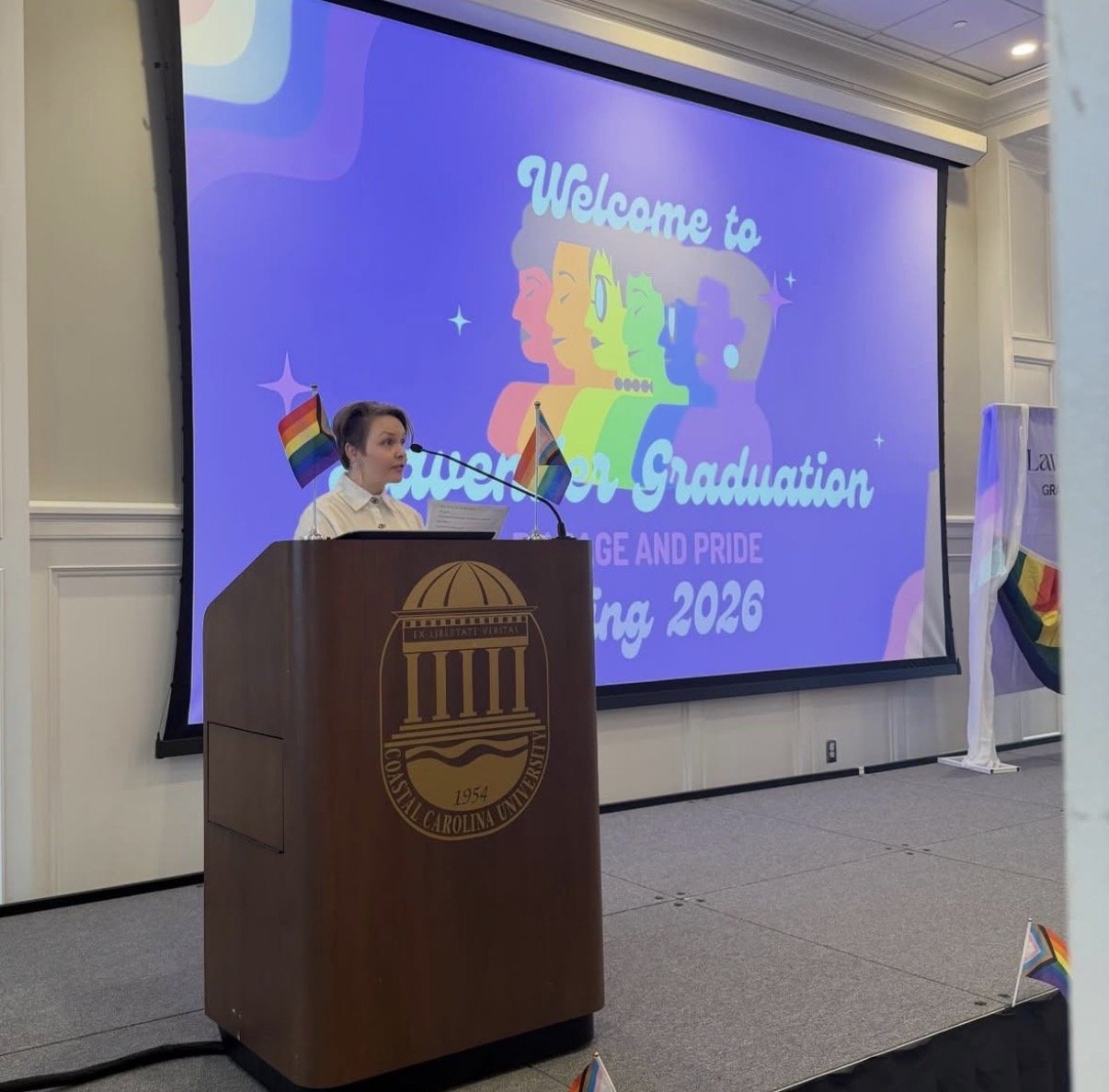
Sandrine Schaefer delivering their keynote at Lavender Graduation at Coastal Carolina University, Conway, SC, Spring 2026, photo by Loren Mixon
This is a celebratory time
and it is also a tender time.
Around the world, people are still discriminated against, jailed, and persecuted for identities that many of us share.
As LGBTQ+ people, we all have felt this to some degree in our own lives.
Maybe it was the bathroom you couldn’t use.
The parent who withdrew support.
The friends who didn’t understand.
The place you couldn’t return to
The frightening news cycles that stole your sleep.
And yet - you are here.
You made it here by becoming more discerning, more empathetic, more yourself. You made it here by holding onto whatever sustained you: a loving friend, an understanding mentor, a caring parent, a place that embraced you as you are, an animal companion who loved you ferociously, or maybe just the determination to prove someone wrong.
Hold onto that. You will need it again.
I am queer.
I first heard the word “queer” as a child - as a warning.
A boundary.
A way to name who to avoid.
But language shifts. Meaning shifts.
Over time, this word became something else.
Not a warning, but a place to stand.
Queer is defined as differing in some way from what is usual, odd, strange, weird, non-conventional. I am someone whose way of being does not fit neatly into boxes. Instead of resisting that truth, the word “queer” has given me permission to live inside it.
I am also an artist.
And like queerness, being an artist resists easy definition. There is no single agreement about what art is, which means there is no single agreement about what it means to be an artist.
So at some point, you have to decide for yourself.
You have to claim it.
Before I could claim the words queer or artist, I needed to learn about something called “the ish.”
I went to a public arts high school in Baltimore. It was the first place where I took seriously the act of studying and making art. It was also where I first felt that something other than the conventional life I was expected to live, was possible.
One day in painting class, we were given a simple assignment: go home, look closely at an ordinary object, and describe its color.
Don’t paint it. Don’t sketch it. Just describe it.
The next day, one by one, we stood up and shared what we saw.
And something strange happened.
No one said “red.”
No one said “blue.”
Intuitively, we all said: reddish. Bluish. Yellowish. Greenish. Purple-ish.
Everything was “ish.”
Because when we really looked - deliberately, attentively, and without turning away - nothing was just one thing.
Everything held multiplicity.
That’s when I learned that being an artist isn’t just about making.
It’s about seeing.
With great enthusiasm, our teacher told us: once you see the “ish,” you can’t unsee it.
He was right.
Decades later, I still see the ish everywhere I go.
With time, I realized that the “ish” is akin to queerness.
It is the refusal to collapse into a single category.
It is the truth that multiple things can exist at once.
It is the understanding that something can be unnameable - and still deeply known.
The “ish” taught me that the world is more expansive than we are often told it is.
And so are we.
I don’t make paintings anymore.
But I still work with the ish.
Today, my artwork reimagines how we (humans) share space
with our more-than-human neighbors. Specifically, I work with geese.
I make sculptures that try to help viewers see the world
in ways a goose might.
Not exactly.
Not accurately.
But… goose-ish.
Because geese see differently than we do. Their vision extends beyond ours in ways that cannot be replicated.
So this is an invitation
not to fully understand another perspective,
but to loosen your grip on your own.
To see beyond what feels fixed.
And maybe you can learn not just from how geese see,
but from how they live.
It’s hard to imagine a time when these birds - the ones we share our skies, parks, ponds, shopping centers and backyards with- were ever under threat of extinction.
But there was a time when Canada geese were nearly gone.
Driven to near-extinction by unregulated hunting.
Today, there are millions.
Their return is conservation, but it is also remarkable adaptability.
They learned to live in landscapes that were not made for them.
They learned to thrive in systems designed to oppress them.
Geese are tenacious.
They are audacious.
And they are deeply communal.
When they fly, they form a V.
The one at the front faces the strongest resistance
but no one stays there forever.
They rotate. They share the work.
On the ground, they do it too.
One goose keeps watch while others eat.
And then, the Lookout lowers their head as another goose steps in to take their place.
There is a lesson in that rhythm:
Leadership is not a position. It is a practice.
Care is not an individual act.
It is a shared responsibility.
And survival is a collective effort.
Geese stay in the same groups for lifetimes. These families are not just biological, but chosen.
They find each other.
They stay together.
and they move forward.
They survive not because they are the strongest individually,
but because they refuse to go at it alone.
And that is what I see when I look at you.
I see people who have already learned
how to find each other.
I see people who have learned to take turns leading.
How to keep watch.
How to create belonging where it did not previously exist.
Whether you knew it or not,
my friends, you are part of a gaggle!
Every great gaggle needs bold thinkers and brave doers.
So take what you have learned here your emotional intelligence, your critical thinking, your creativity, your resilience and put it to work.
Open doors that do not close behind you.
Build paths that others don’t have to fight to find.
Make room, not just for yourselves,
but for the people who are still on their way.
Because there is still so much at stake.
AND there is so much possibility.
In my lifetime, I have seen change that once felt impossible. I have seen rights expand, visibility grow, and ways of being move from the margins toward the center.
I have also seen how fragile that progress can be.
So what you do next matters.
Not someday.
Now.
As you leave this place,
take your ways of seeing with you.
See the “ish” in the world and in each other.
Do not settle for landscapes that aren’t designed for you.
Do not settle for systems that oppress you.
Be tenacious.
Be audacious.
And when the winds are strong…
and they will be…
take your turn at the front.
And trust that when you need to rest,
your community will carry you.
- Sandrine Schaefer
Keynote Speaker, Lavender Graduation, Coastal Carolina University, Spring 2026